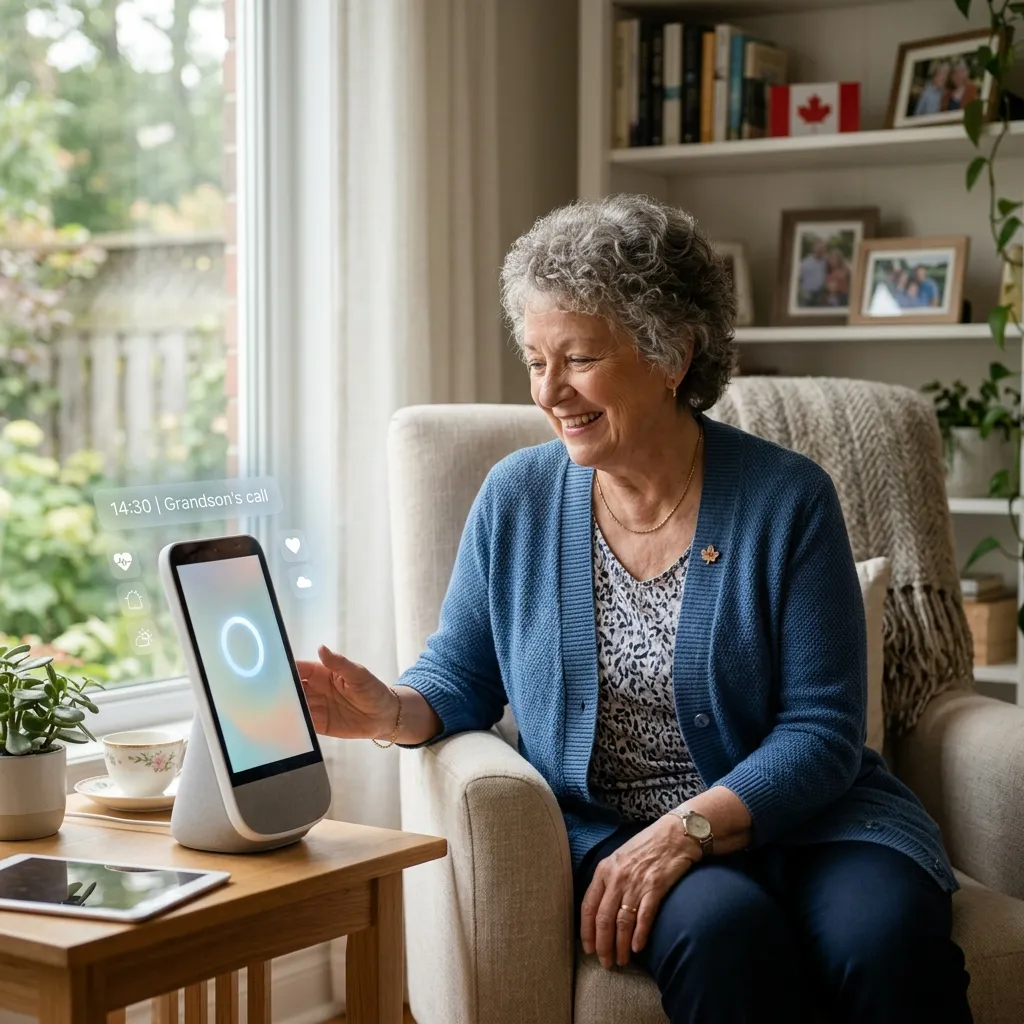

It sounded exactly like her grandson. It used his nickname. It was crying. And the voice could have been recreated from audio shared online.
The phone rings at 10:40 on a Tuesday morning. Your mother picks up, because she always picks up.
"Grandma? It's me. Please don't be mad."
The caller says he has been in a car accident and needs bail. A calm, official-sounding "lawyer" takes the phone, warns her about a gag order and says a courier can collect $9,000 from the house. By noon the money is gone. She stays silent for three days because she was told not to tell anyone — and because she is ashamed.
Her grandson was at work the whole time. He never made the call.
This opening is an illustrative composite, but every tactic in it appears in official Canadian fraud warnings: a distressed relative, a fake authority figure, secrecy, urgent bail money and a courier sent to the victim's home.
Need care for your parent?
Get a professional care assessment at no cost.
This is not your grandmother's phone scam anymore
The emergency or grandparent scam is not new. What has changed is how convincing impersonation can become. Competition Bureau Canada warns that artificial intelligence can clone a person's voice and create fake audio, while the Canadian Anti-Fraud Centre warns that callers may pose as a relative, lawyer, police officer or justice official.
That changes the advice families once gave their parents: "You would know if it was not really him." A familiar voice is no longer proof. Caller ID is not proof either; phone numbers can be spoofed. The reliable protection is an independent check using contact information you already trust.
The scale of fraud is much wider than one scam type. The Canadian Anti-Fraud Centre received 108,878 fraud reports involving more than $638 million in reported losses in 2024. The CAFC estimates that only 5% to 10% of fraud incidents are reported, so reported losses show only part of the harm.
Why smart, careful people fall for it
Families often assume a victim was careless. That response misunderstands how the scam is engineered. Each part of the script is designed to bypass reflection and keep the victim alone.
Panic narrows the problem. A grandchild in danger gives the listener one urgent goal: make the danger stop. Verification can feel like abandoning someone they love.
Secrecy removes the people who would spot it. "Do not tell Mom and Dad" and "there is a gag order" are not background details. They prevent the one phone call that could end the fraud.
Authority makes the story feel official. A second person claiming to be a lawyer, police officer or court employee makes the request sound procedural rather than suspicious.
Speed leaves no room to think. Same-day deadlines, repeated calls and couriers keep the victim reacting. Canadian police have documented scammers sending people to victims' homes to collect cash.
Isolation makes every tactic easier. A person who lives alone and has nobody nearby to consult must make the decision alone. Memory changes can increase vulnerability, but the scam is designed to manipulate people of any age. The victim is not the weak point; the scam depends on separating them from a second opinion.
Want more deep knowledge like this?
Join our private Facebook group to connect with experts, get exclusive resources, and find support from families navigating the same journey.
The red flags, in plain language
Print this list and place it beside the phone.
Hang up when a caller:
- Says a family member is in trouble and needs money immediately
- Asks you to keep the call secret or mentions a gag order
- Wants cash collected by courier or asks for gift cards, cryptocurrency or a transfer
- Hands the call to a supposed lawyer, police officer or bail clerk
- Becomes angry or pushy when you say you will call someone first
- Calls from an unfamiliar or apparently official number and treats caller ID as proof
One fact is worth remembering above everything else: Canadian courts do not ask for cash to bail someone out by sending a courier to your home. The Canadian Anti-Fraud Centre advises people to hang up, contact the family member directly and call local police when an emergency call demands immediate payment.
The family habit that stops the script
You cannot prevent every scam call. You can make the script fail when it arrives. Set these rules at the next family conversation.
1. Agree on a family code word. Choose something that is not online, is not a pet's name and cannot be guessed from social media. A copied voice can imitate how someone sounds; it cannot know a secret your family never posted.
2. Make "hang up and call back" the house rule. End the call and dial the grandchild or their parent using the number already saved in the phone. Never call a number supplied by the caller. A real emergency survives a two-minute verification.
3. Give your parent permission to be rude. Many older adults were taught never to hang up. Say clearly that ending an unexpected call is allowed and nobody in the family will be offended.
4. Let unknown numbers go to voicemail. A message turns a split-second decision into something that can be checked with another person.
5. Reduce public voice and family clues. Review privacy settings on accounts with videos, names and family relationships. Avoid public posts that connect a grandchild's voice, nickname and grandparent in one place.
6. Ask the bank about safeguards. Discuss alerts for unusual withdrawals, transaction limits and whether the bank offers a trusted-contact option. Never share online banking credentials or one-time verification codes with a caller.
If it has already happened
If a courier is at the home or a crime is in progress, call 911. If money has been sent or collected, contact the bank immediately, then report the incident to local police and the Canadian Anti-Fraud Centre at 1-888-495-8501 or through its Fraud Reporting System. Report attempted fraud even when no money was lost; reports help investigators connect related cases and warn others.
Then address the part people rarely discuss: shame. Underreporting is partly driven by embarrassment, and previous victims can be targeted again through recovery scams. Tell your parent that this was a crime committed against them by professionals. It says nothing about their intelligence. Lead with reassurance, protect accounts and devices, and work through the reporting steps together.
The protection no technology can replace
Call screening and code words help. The strongest defence against a scam that depends on isolation is still another trusted person.
Someone who is present when the phone rings. Someone who notices the unfamiliar car, the anxious mood, the envelope on the table or the new caller demanding secrecy. Someone your parent trusts enough to tell, "This might be nothing, but something feels wrong."
For families who live an hour or more away, that person may not be available every day. Regular support does not take away independence. It can preserve it by making it easier to pause, verify and ask for help before a pressured decision becomes an irreversible loss. Read for a deeper look at the risks of isolation.How Corelia Health helps
Corelia Health does not sell fraud-protection technology. We provide regular, trusted human presence that makes isolation-based scams harder to carry out.
"She lives alone and answers every call." Companion care provides regular visits for conversation, errands, appointments and outings. A familiar caregiver can become someone the client naturally consults when a call feels wrong.
"We live two hours away and would not know something had changed." Local caregivers provide consistent visits and agreed family updates. Someone who knows the client's usual routine may notice unusual distress, repeated unknown callers or unexpected visitors.
"His memory is changing and he is more trusting with strangers." Dementia and Alzheimer's care adds calm structure and supervision. Care plans are overseen by our Clinical Director, a Registered Nurse.
"She is managing, but she is more isolated than she admits." Elderly care and personal care assistance help with meals, routines and daily tasks while building consistent human connection. Loneliness is a health risk in its own right.
Corelia caregivers are bonded, WSIB/WCB insured and cleared through vulnerable-sector police checks. We offer free assessments, no long-term contracts and flexible care plans. Families often begin with two or three visits a week. We serve communities across Ontario and Alberta, including Mississauga, Brampton, Caledon, Oakville, Burlington, Milton, Halton Hills, Guelph, North Bay, Edmonton and Red Deer.
Have the code-word conversation this week
Share this article in the family group chat and choose the code word tonight. Make the callback rule clear to every generation. If your parent spends most days alone, a free, no-obligation conversation with a care coordinator can show what regular support would look like without taking over their life.
, take the two-minute care needs quiz, or call 1-844-826-7354.Official sources
- Fraud Prevention Month 2025 and 2024 reported losses — Canadian Anti-Fraud Centre
- Emergency and grandparent scam warning — Canadian Anti-Fraud Centre
- The rise of AI: fraud in the digital age — Competition Bureau Canada
- Okotoks RCMP grandparent-scam courier case — Royal Canadian Mounted Police
- Why reporting matters — Canadian Anti-Fraud Centre
Frequently Asked Questions
Yes. Frame it as a family-wide safety rule rather than something she needs because she is older. Everyone learns the code word, everyone hangs up and calls back, and nobody treats a familiar voice or caller ID as proof.
Caller ID can be spoofed. End the call and dial the family member using the trusted number already stored in your phone. Do not use a callback number supplied during the suspicious call.
Common examples include callers impersonating banks, the Canada Revenue Agency or government agencies, romance scams, investment fraud, tech-support scams and recovery scams. Urgency, secrecy, requests for unusual payment methods and pressure not to verify are recurring warning signs.
Begin with reassurance rather than blame. Help her contact the bank, local police and the Canadian Anti-Fraud Centre. Review account and device security, and consider whether regular support would make it easier for her to ask for a second opinion next time.
Corelia Premium Guide
Use this guide to compare care options, prepare family questions, and understand what to check before starting in-home support.
Professional Care Services
Local Home Care Support
Why Corelia Health?
-
Customized care plans tailored to your unique needs and preferences.
-
Screened caregivers matched to the care plan, schedule, and level of help required.
-
Ongoing monitoring and regular family updates for peace of mind.
-
Locally owned and operated, providing a personalized community touch.
"We help at home, wherever home is for you."
Find The Right CareSpeak to our Clinical Care Coordinator
We are here to walk this journey with you. Our coordinators provide expert guidance on care options, funding, and next steps.