
There's a particular kind of dread that starts around four in the afternoon. You've learned to watch the light. And you've probably started to wonder what you're doing wrong.
All morning she was fine. Slow, a bit repetitive, but herself. You had a cup of tea together and she asked about the grandchildren twice and it was a good day.
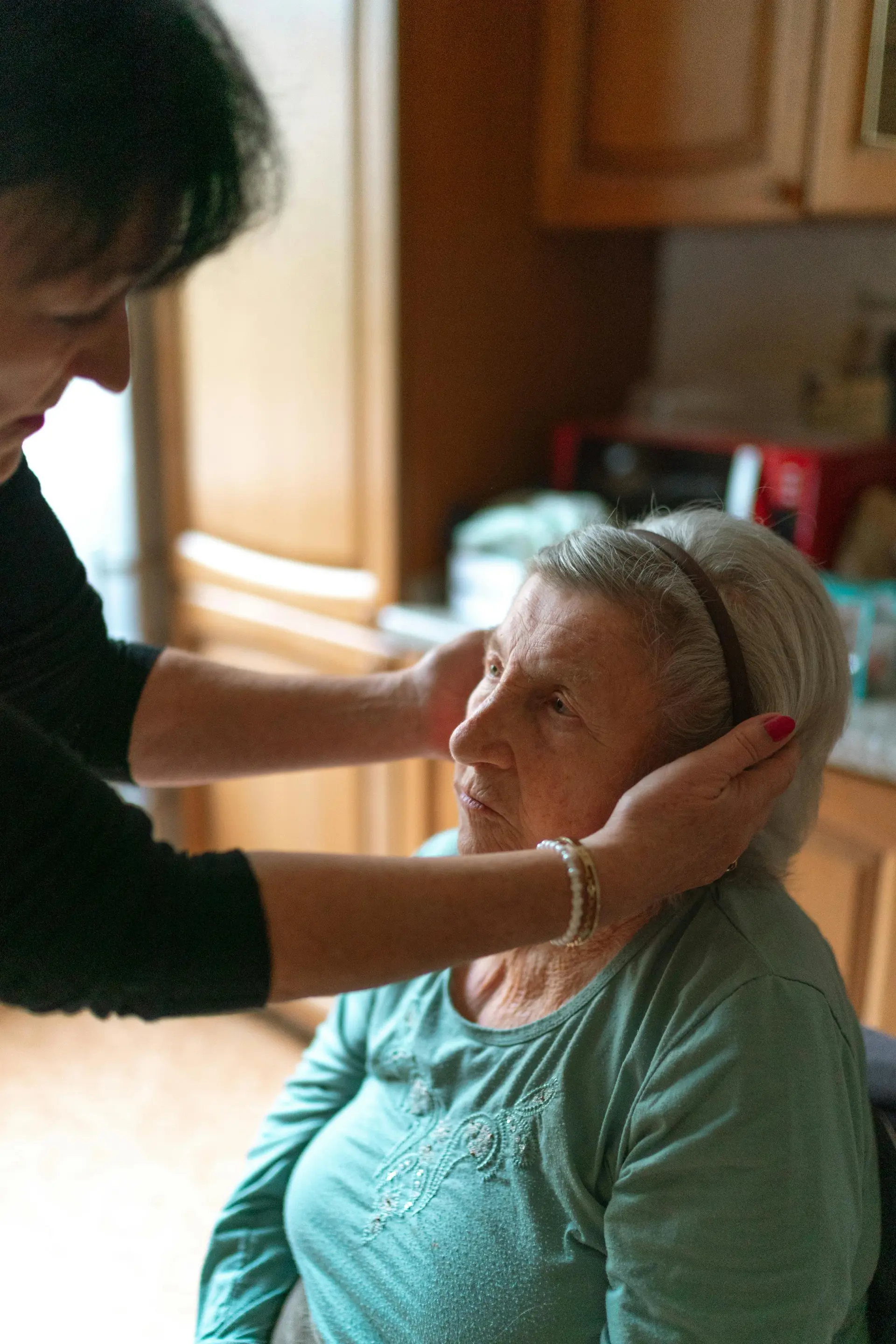
Then somewhere around half past four something shifted. She started moving from room to room. She wanted to go home, in the house she has lived in for thirty-one years. She followed you into the kitchen, and then followed you out of it, and then asked where her mother was. By six she was frightened and angry and you were trying to get dinner on the table while explaining, for the fifth time, that her mother died in 1987.
By nine it had passed. By morning she remembered none of it.
This has a name. It is extremely common, it is not caused by anything you did, and — the part most families never hear — it is not really behaviour at all.
Need care for your parent?
Get a professional care assessment at no cost.
What sundowning actually is
Sundowning, sometimes called sundown syndrome or late-day confusion, is a pattern of increased confusion, restlessness, anxiety, agitation, pacing, wandering and sometimes hallucination that begins or intensifies as the afternoon light fades. It usually eases overnight and is often gone by morning.
It is not a disease and not a diagnosis in its own right. It's a recognised pattern that shows up in dementia, most often in the middle and later stages.
How common is it? Honestly, the research is a mess on this point — estimates range from under three per cent to around two thirds of people with dementia, depending entirely on how each study defines it. One 2023 study of 184 people with Alzheimer's and dementia found about one in five affected. What that spread really tells you is that a great many families are living with this, and that nobody should feel like an outlier for it.
Why evenings
Several things stack up at the same hour, which is why the effect is so reliable.
The clock is damaged
Deep in the brain sits a small structure called the suprachiasmatic nucleus — the body's master clock. It's what keeps your sleep, alertness, hormones and body temperature aligned to the actual time of day. In dementia, this structure degenerates, and melatonin production falls and loses its normal daily rhythm.
So the internal timekeeping that tells a healthy brain "it's evening, wind down" is no longer working properly. Research has linked sundowning specifically to a shift in the body's daily temperature rhythm — the clock isn't just weakened, it's running out of step with the world outside the window.
This is the single most important thing to understand, because it reframes everything else. Your mother is not choosing this hour to be difficult. Her clock is broken and the evening is when the mismatch shows.
The day's reserve has run out
Living with dementia is cognitively expensive. Holding a conversation, working out where you are, deciding what to do next, keeping track of who people are — things that cost you nothing take enormous effort. By late afternoon that effort has been going on for ten hours and the reserve is spent.
Anyone gets short-tempered and muddled when exhausted. Take away the brain's capacity to compensate and exhaustion looks like this instead.
The light stops helping
Fading daylight removes the visual information the brain uses to make sense of a room. Shadows lengthen. Reflections appear in dark windows. A coat on a hook becomes a person standing in the corner. A brain already struggling to interpret what it sees now has less to work with, and misperception becomes far more likely.
Early evening is the busiest, loudest part of the day
Dinner being made, the television on, people coming home, phones going, lights being switched on and off. And the person providing care is at their most depleted at precisely the hour that requires the most patience — which is not a moral failure, it is arithmetic.
She isn't giving you a hard time in the evenings. Her body clock has stopped telling her what time it is, and evening is when that becomes unbearable.
Want more deep knowledge like this?
Join our private Facebook group to connect with experts, get exclusive resources, and find support from families navigating the same journey.
What it looks like
Restless
Pacing, moving room to room, unable to settle, trying doors, searching for something unnameable.
Shadowing
Following you everywhere, into every room, unable to tolerate being out of your sight. Exhausting in a way that's hard to explain to anyone who hasn't lived it.
Wanting home
Asking to go home while at home, or asking for a parent who died decades ago. Usually an expression of wanting safety rather than a factual claim about geography.
Agitated
Anxiety, irritability, shouting, tearfulness, resistance to care, sometimes aggression in someone who has never been aggressive in their life.
Confused
Markedly worse orientation than earlier the same day. Harder to follow a conversation at six than at ten in the morning.
Seeing things
Hallucinations and delusions, often triggered by shadows, reflections, or patterned fabric in dim light.
Awake at night
Trouble settling, waking repeatedly, getting dressed at three in the morning, wandering while the house sleeps.
Before you treat it as sundowning, rule these out
This is the step families skip, and it is the one most likely to produce a real improvement.
Agitation in someone who cannot easily explain what's wrong is often a message about an unmet need. If she can't tell you her hip hurts, she can only show you.
Check the simple things first
Pain. Arthritis, a pressure sore, dental pain, an old injury. Under-treated pain is a leading and badly overlooked cause of agitation in dementia.
The bathroom. A full bladder or constipation, in someone who no longer recognises or can articulate the sensation.
Hunger and thirst. Blood sugar drops through the late afternoon in everyone.
Infection. A urinary tract infection can cause a sudden, dramatic increase in confusion in an older adult with no fever and no pain at all. If this got much worse suddenly rather than gradually, call the doctor before doing anything else.
Medication. A 2023 study found sundowning associated with anticholinergic and antipsychotic medication use. Timing matters too — something sedating or activating taken mid-afternoon lands right in this window. Worth a full medication review.
Hearing. The same study found an association with hearing loss. Someone who cannot make out what's being said in a noisy kitchen at dinnertime is being asked to navigate a world that has become incomprehensible. Get the hearing checked and the hearing aids working.
Overtiredness. A long day, a big outing, a hospital appointment, three visitors. Sundowning is often much worse on days that asked too much.
What actually helps
Non-medication approaches come first, because they're safe and because the medication options are genuinely limited. None of this eliminates sundowning. Done together, it often takes the edge off substantially.
Reshape the day, not just the evening
Front-load everything demanding. Bathing, appointments, hair, outings, visitors, difficult conversations — all before lunch where possible. Nothing hard after three o'clock.
Get real light and movement into the morning. Bright light early is the most studied non-drug approach for the underlying rhythm problem. The trial evidence is honestly mixed, but a walk outside after breakfast or a chair by the brightest window costs nothing and has no downside.
Turn the lights on before the light fades. Not after. Get the room fully and evenly lit before dusk arrives, and close the curtains before the windows turn into black mirrors. This one is small and it matters.
Make early evening the quietest part of the day. Television off, or something familiar and gentle — never the news. Fewer people in the room, less clutter, lower voices.
Keep the same order every day. A predictable sequence carries someone who can no longer hold a plan in mind. Same time, same chair, same routine.
Watch naps and caffeine. Short and early is fine; a long late-afternoon sleep tends to make the night worse. Caffeine and heavy sugar earlier in the day.
Eat the main meal earlier if the six o'clock scramble is itself a trigger, and keep something to hand for the late-afternoon dip.
Give her something to do with her hands. Folding towels, sorting cutlery, a familiar simple task. Purposeful occupation settles restlessness better than being asked to sit still.
In the moment
When it's happening, the instinct is to correct. Resist it — arguing with a delusion has never once worked and it escalates distress every time.
Answer the feeling instead of the fact. "Where's my mother?" is usually a request for safety, so "you're safe here with me, I'm not going anywhere" does more than any true statement about 1987. Keep your voice low and slow. Don't take it personally when someone you love is unkind at six o'clock. Then redirect — a snack, a drink, music from their twenties, a walk to the end of the hall and back.
And if you feel your own patience go, it is entirely reasonable to step into another room for two minutes, provided she's safe. Leaving briefly is better than staying and snapping.
Find your hour
Keep a simple log for two weeks: the time it started, what happened beforehand, what she'd eaten, how she slept, what the light was like, what helped. Patterns emerge that nobody could see from inside the day. Some families discover their trigger isn't the light at all — it's the four o'clock news, or a nap that ran too long, or a medication taken at three.
That log is also the single most useful thing you can hand her doctor.
On medication
The evidence base for treating sundowning is limited and of modest quality, which is why non-drug approaches come first. There is some support for melatonin improving night-time agitation and sleep in dementia — but it interacts with other medications and should only be started after speaking with her doctor, over-the-counter availability notwithstanding.
Antipsychotics are sometimes used and carry meaningful safety concerns in dementia. Benzodiazepines are generally not recommended for older adults. These are decisions for a physician who knows the full picture, not something to work out from an article.
The part nobody says out loud
Sundowning is one of the most common reasons a family stops being able to keep someone at home.
Not because they stopped loving them. Not because they didn't try. Because it is not humanly possible for one person to hold together the hours from four in the afternoon until midnight, and then be woken at two, and then get up and do it again, for eighteen months, alone.
That is the actual shape of the problem. It isn't a knowledge gap — most families reading this already know about the lights and the routine. It's a coverage gap. There are more difficult hours in the day than there are people to cover them.
Which is a solvable problem, and it's the one we exist to solve.
How Corelia Health helps
"From four o'clock onwards I'm on my own with it, every single day."
Dementia and Alzheimer's care, on an evening schedule. Care doesn't have to be booked in the morning. A caregiver present through the specific hours that are hardest — arriving before the difficult window opens, staying through dinner and settling — changes the whole day. Caregivers are trained for cognitive change and work with redirection and routine rather than correction.
"She's up at three in the morning and I haven't slept properly in a year."
Overnight and 24/7 care. Awake overnight support or full round-the-clock coverage, so someone is there when she gets dressed at 3am and it doesn't have to be you. Sleep is not a luxury for a family caregiver — it's the thing that determines whether the arrangement survives.
"I don't know what's setting it off."
Observation and care planning. A caregiver who is present through the same hours several times a week sees the pattern you can't see from inside it — the timing, the triggers, what settles her. Care plans are overseen by our Clinical Director, a Registered Nurse, and what a caregiver observes is exactly what her doctor needs to hear.
"I've got nothing left. I snapped at her last night and I've felt sick about it since."
Respite care. Scheduled breaks — an evening, a weekend, a fortnight. Losing your temper at six o'clock after eleven hours isn't a character flaw; it's what happens to everyone eventually. Respite exists so it doesn't have to keep happening.
"We're starting to talk about a home, and I don't want to."
Coverage before a decision. Plenty of families reach this point purely on exhaustion rather than need. Before deciding anything permanent, it's worth finding out what the evenings would feel like with help in them. Free assessment, no long-term contracts, and most families start with two or three visits a week.
We support families in Mississauga, Brampton, Caledon, Oakville, Burlington, Milton, Halton Hills, Guelph, North Bay, Edmonton and Red Deer. Caregivers are bonded, WSIB and WCB insured, and cleared through vulnerable sector police checks.
You don't have to do the evenings alone
A free, no-obligation conversation with a care coordinator about what your evenings actually look like and what coverage would help. Tell us the hours that are hardest and we'll tell you honestly what's possible. If you'd rather start smaller, our care needs quiz takes about two minutes.
Or call 1-844-826-7354Frequently Asked Questions
It's more common in the middle and later stages, so its appearance can reflect progression — but it isn't a reliable measure of it, and it can fluctuate week to week for reasons that have nothing to do with the underlying disease. A sudden dramatic worsening is more likely to mean infection, pain or a medication problem than a step change in the dementia, and should be checked.
For some people it lessens in the later stages as activity levels fall overall. That's not much comfort in the middle of it, but it is worth knowing that this is a phase rather than a permanent fixture.
Late-day confusion also appears in delirium, which is an acute and often reversible state caused by infection, medication, dehydration, pain or a hospital stay. Delirium comes on over hours or days rather than months and is a medical urgency. If confusion appeared suddenly in someone who was previously clear, that's a call to the doctor today.
Safety comes first — yours and hers. Don't try to physically manage or restrain someone; give space where you safely can, remove obvious hazards, and raise it with her doctor promptly, because aggression is often driven by pain, fear or a treatable cause. If anyone is in immediate danger, call 911. This is also a clear signal that the arrangement needs more hands in it, not more willpower from you.
Corelia Premium Guide
Use this guide to compare care options, prepare family questions, and understand what to check before starting in-home support.
Professional Care Services
Local Home Care Support
Why Corelia Health?
-
Customized care plans tailored to your unique needs and preferences.
-
Screened caregivers matched to the care plan, schedule, and level of help required.
-
Ongoing monitoring and regular family updates for peace of mind.
-
Locally owned and operated, providing a personalized community touch.
"We help at home, wherever home is for you."
Find The Right CareSpeak to our Clinical Care Coordinator
We are here to walk this journey with you. Our coordinators provide expert guidance on care options, funding, and next steps.