
Of everything on the list of things you can actually change, this one sits near the top. And the appointment that addresses it costs almost nothing compared with what families spend worrying about the alternative.
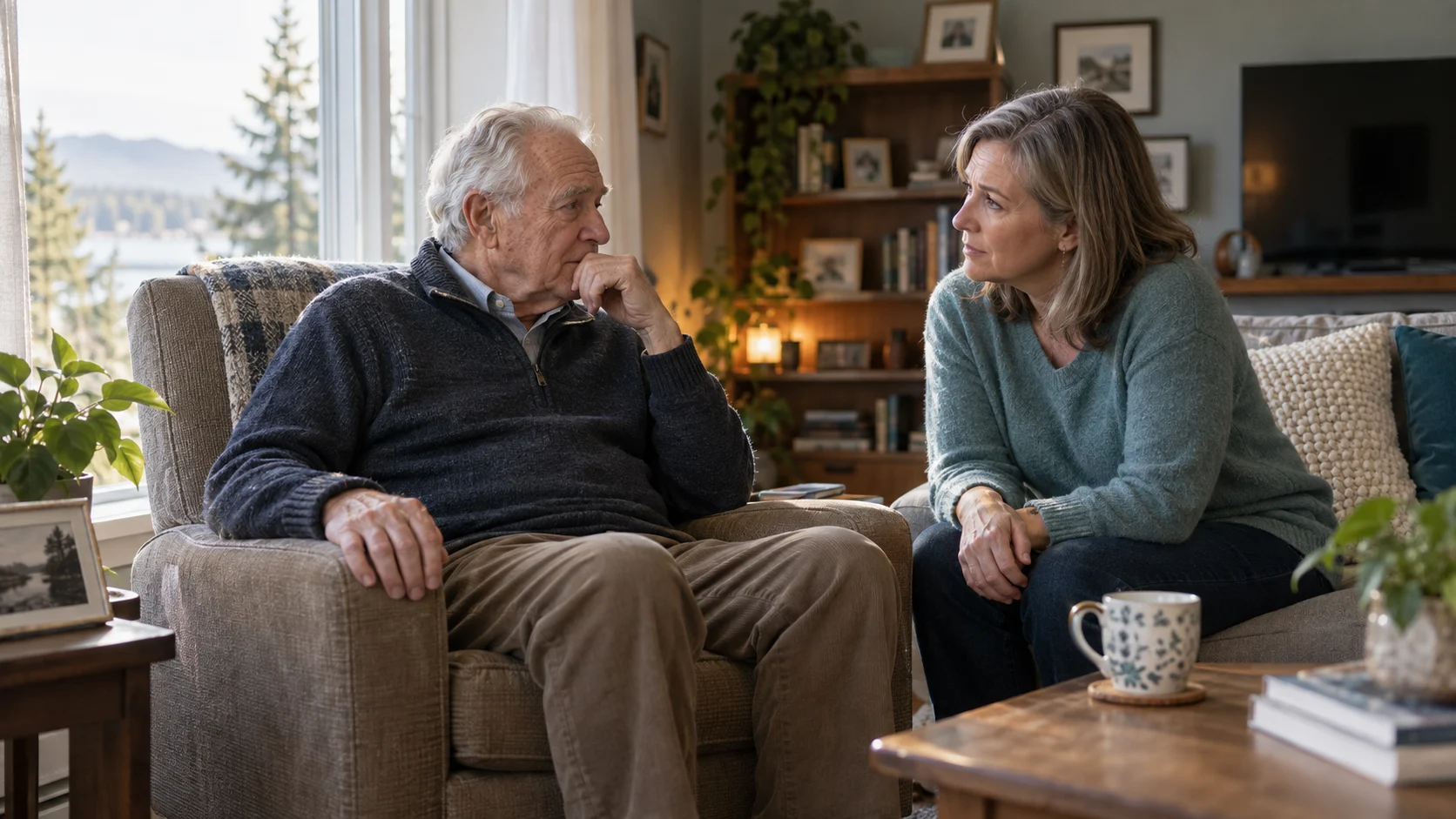
Your father is at the far end of the table at a family dinner. Someone tells a story, everyone laughs, and he laughs a beat after them. Your sister asks him a question and he answers something adjacent to it. Later he goes quiet and watches.
In the car home somebody says the thing everyone's been thinking. He's really slipping, isn't he.
Maybe. Or maybe he heard about sixty per cent of that evening and filled in the rest from context, and he's been doing it for four years, and he's exhausted.
Need care for your parent?
Get a professional care assessment at no cost.
What the evidence says
The Lancet Commission on dementia prevention is one of the most influential bodies in this field. Its 2024 report identified 14 modifiable risk factors that together account for around 45% of dementia cases worldwide — meaning that close to half of dementia might, in principle, be prevented or delayed by addressing things we can actually change.
Hearing loss accounts for an estimated 7%. The Commission estimated that hearing loss accounts for about 7% of dementia cases globally, making it one of the largest contributors among the 14 factors — alongside high LDL cholesterol and ahead of smoking, obesity, diabetes, hypertension and physical inactivity. In the Commission's earlier 2020 report, it was the largest single factor outright, at 8%.
The Commission's recommendations are explicit: make hearing aids accessible for people with hearing loss, and reduce harmful noise exposure. That is a public-health recommendation, not lifestyle advice from a magazine.
Why would hearing affect the brain?
Nobody is certain, and several plausible mechanisms probably operate together.
The brain runs out of capacity. When sound arrives degraded, the brain has to work considerably harder to decode it. Resources that would otherwise go to understanding, remembering and responding get spent on the decoding itself. Sustained over years, that is a constant tax on the same systems that memory relies on.
People withdraw. Following a conversation with three people in a noisy room becomes exhausting, then embarrassing, then not worth it. So invitations get declined. Social isolation is itself a separate risk factor on the Commission's list — which means untreated hearing loss can pull two levers at once.
Mood follows. Being cut off from conversation is isolating and demoralising, and depression appears on the list as well. The pathways compound rather than sitting in separate boxes.
The brain may change structurally. There is evidence that reduced auditory input is associated with changes in brain structure over time. This is an active research area and the picture is not settled.
Want more deep knowledge like this?
Join our private Facebook group to connect with experts, get exclusive resources, and find support from families navigating the same journey.
The honest caveat
You will see headlines claiming hearing aids cut dementia risk by half. The real finding is narrower and worth knowing.
The ACHIEVE randomised trial found hearing-aid use was associated with a 48% reduction in three-year cognitive decline within a higher-risk subgroup — participants with lower baseline cognition and greater cardiovascular risk. In the healthier overall group, there was no significant effect over that three-year window, though the researchers noted longer follow-up might be needed.
So the fair summary is this: hearing aids appear particularly valuable for people who have hearing loss plus other dementia risk factors. That is exactly the group many families are worried about. But it is not a guarantee, and anyone selling it as one is overstating the science.
The more immediate problem: it looks exactly like dementia
Set the long-term risk aside for a moment, because there is a nearer issue that affects families right now.
Untreated hearing loss produces a pattern that is very difficult to distinguish from early cognitive decline. Someone who mishears a question answers the wrong thing. Someone who did not catch an arrangement does not remember it, because they never had it. Someone who cannot follow group conversation goes quiet and stops attending. Someone tired from a day of straining to listen is irritable and vague by evening.
Confused. Forgetful. Withdrawn. Losing interest. Worse in the evenings.
Every one of those goes in the mental file marked dementia. Before you conclude that your father is losing his memory, find out whether he heard the question.
This matters beyond reassurance. A hearing test is quick, low-cost and low-risk. It should come before, not after, the conclusion that a decline is progressive — and it belongs alongside other treatable things to rule out, which we covered in Is my dad depressed or is this dementia?.
There is a link to the harder end of dementia care too. Research on sundowning has found an association with hearing loss — which makes sense if you picture someone trying to interpret a noisy kitchen at dinnertime with degraded input and a tired brain. Our piece on why the evenings are worse covers that pattern.
Why he will not wear them
Most families reading this already know their parent has hearing loss. The problem is not the diagnosis. It is the drawer with two hearing aids in it that have not been worn since 2019.
The reasons are consistent and mostly reasonable:
Vanity and what they signify. Glasses read as ordinary; hearing aids still read as old. That is changing slowly, and modern devices are far less visible than the ones your parent remembers.
They were never fitted properly. Hearing aids need adjustment and follow-up. A device that whistles, amplifies the wrong things or makes a restaurant unbearable gets abandoned, understandably.
They are fiddly. Tiny batteries and small controls are genuinely difficult with arthritic hands or poor eyesight. This is a practical obstacle, not a lack of willingness.
The adjustment period is unpleasant. The world comes back too loud at first, and the brain needs weeks to recalibrate. Plenty of people quit in the first fortnight, right before it would have started working.
Cost. Real and substantial in Canada — see below.
They do not believe they need them. Hearing loss is gradual, so there is no moment of noticing. From inside, it feels like everyone else has started mumbling.
What actually helps
Frame it as something for you, not about him. “I hate that you're missing what the grandchildren say” lands better than “you can't hear.”
Go to the appointment with him. People retain very little from a solo audiology appointment, and follow-up is where success is decided.
Insist on the follow-up adjustments. The first fitting is rarely the right fitting.
Start at home, one hour a day, in a quiet room. Restaurants are the hardest environment and the worst place to begin.
Look at rechargeable models if dexterity is an issue. It removes the battery problem entirely.
Paying for it in Canada
Hearing aids are expensive and coverage is patchy, which is a genuine barrier rather than an excuse. Ontario's Assistive Devices Program contributes toward the cost for eligible residents, and Alberta Aids to Daily Living does the same in Alberta. Veterans may have coverage through Veterans Affairs Canada, and many extended health plans contribute something.
Amounts and eligibility rules change, so check current figures with the programs directly. An audiologist's office will usually know the details and help with the paperwork.
How Corelia Health helps
Hearing is not a service we sell. It shows up in our work constantly all the same, because the practical business of using hearing aids every day is exactly the kind of thing that determines whether they get used at all.
“She has hearing aids but they're always in the drawer.”
Personal care assistance. Daily support with putting them in, cleaning them, changing or charging batteries, and noticing when something has stopped working. For someone with arthritis or poor eyesight, this single practical task is often the difference between a device that is worn and one that is not.
“He has not had his hearing checked in a decade.”
Companion care. Support getting to appointments and the follow-up fittings that decide whether hearing aids work — the ones that get skipped when nobody is available to go along.
“We cannot tell if it is his hearing or his memory.”
Observation between appointments. Caregivers who are present regularly can note what he responds to and what he misses, and whether difficulty tracks with noise or with the subject. That is useful information for a doctor, who sees him one-to-one in a quiet room where hearing loss hides well. Care plans are overseen by our Clinical Director, a Registered Nurse.
“She has stopped going to anything.”
Regular visits and social connection. Withdrawal is where hearing loss does its compounding damage. One-to-one conversation is far easier to follow than a group, which means a caregiver's visit is often the most accessible social contact in someone's week.
“Her dementia gets much worse in the evenings.”
Dementia and Alzheimer's care. Caregivers trained for cognitive change work with clear, unhurried communication, reduced background noise and good lighting — adjustments that matter a great deal more when hearing is also compromised.
Free assessments, no long-term contracts, and most families start with two or three visits a week. We serve Mississauga, Brampton, Caledon, Oakville, Burlington, Milton, Halton Hills, Guelph, North Bay, Edmonton and Red Deer.
Book the hearing test. Then let's talk about the rest.
Of all the things on the dementia risk list, this is among the cheapest and most straightforward to act on — and it may also explain some of what you have been worrying about. When you are ready to talk about support at home, a free, no-obligation conversation with a care coordinator is here, and our care needs quiz takes about two minutes.
or call 1-844-826-7354.Frequently Asked Questions
Yes, and arguably more so. Hearing loss makes an already confusing world harder to interpret, and correcting it can improve communication, engagement and day-to-day distress even when the dementia itself is unchanged. It is worth raising with his doctor.
The dementia-prevention argument is strongest earlier in life, but the quality-of-life argument holds at any age. Being able to hear your family is worth doing for its own sake, regardless of what it does or does not do to long-term risk.
Availability and regulation vary in Canada, and they suit mild to moderate loss better than severe loss. The trade-off is the professional fitting and follow-up, which are a large part of whether a device gets worn. An audiologist assessment first is the sensible starting point.
Sometimes, yes. Impacted earwax is a genuine and entirely reversible cause of hearing loss in older adults, and it is routinely missed. It is one of the first things worth having checked.
Corelia Premium Guide
Use this guide to compare care options, prepare family questions, and understand what to check before starting in-home support.
Professional Care Services
Local Home Care Support
Why Corelia Health?
-
Customized care plans tailored to your unique needs and preferences.
-
Screened caregivers matched to the care plan, schedule, and level of help required.
-
Ongoing monitoring and regular family updates for peace of mind.
-
Locally owned and operated, providing a personalized community touch.
"We help at home, wherever home is for you."
Find The Right CareSpeak to our Clinical Care Coordinator
We are here to walk this journey with you. Our coordinators provide expert guidance on care options, funding, and next steps.