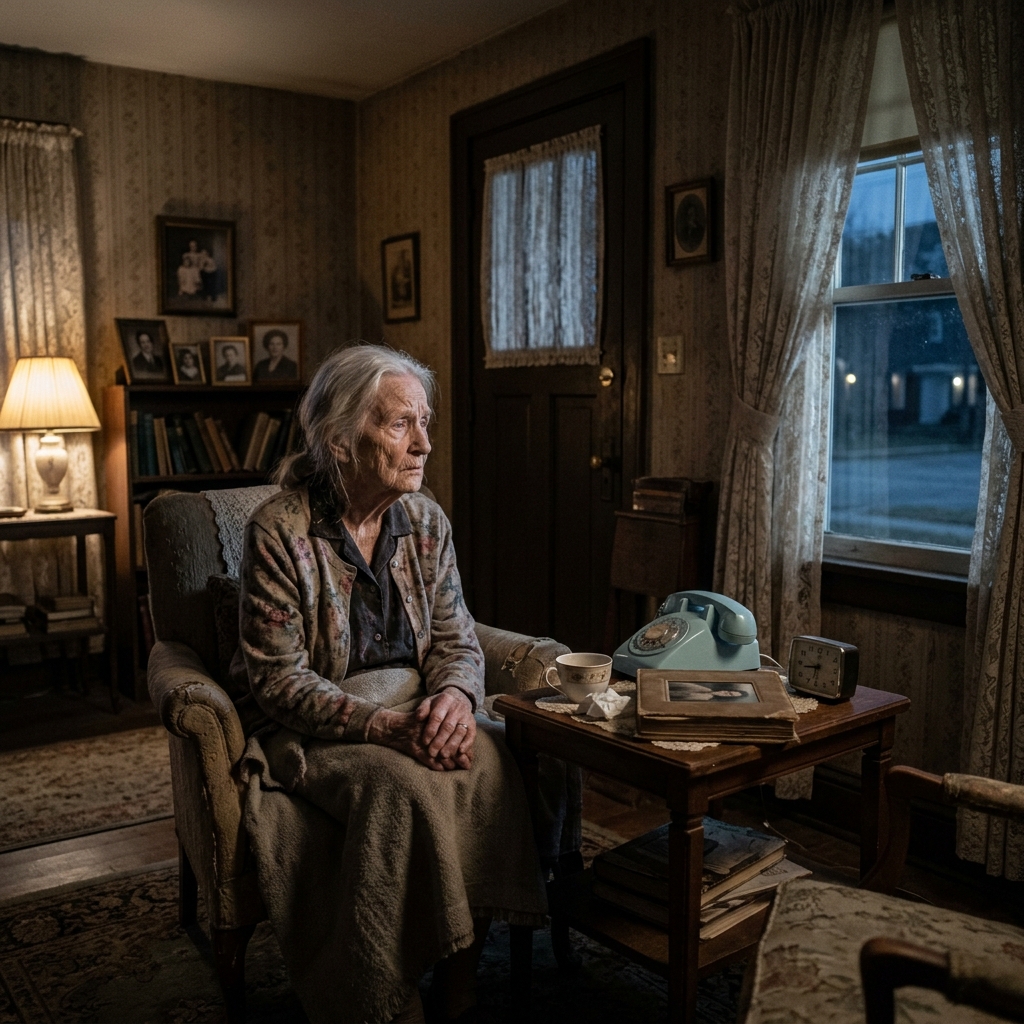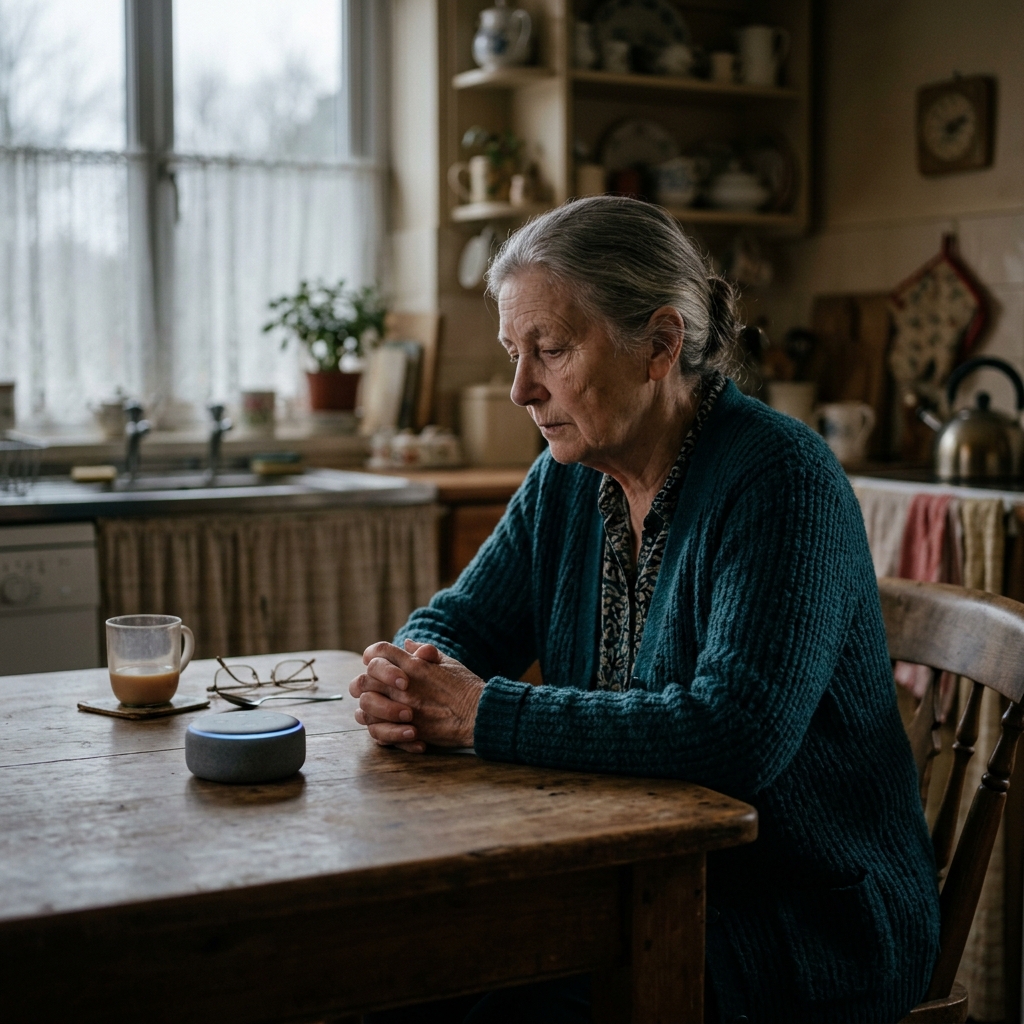

There is no funeral for this. No cards, no casseroles, nobody asking how you're holding up. Just a slow, private loss that most people have never been given the words for.
Margaret noticed it in the car park of her mother's specialist appointment. Her mother had been slow getting out of the passenger seat, and Margaret heard herself say, in a bright voice she did not recognise, "There we go. Good girl."
She sat with her hand on the roof of the car and could not move. It was the voice she had used with her own daughter, twenty-five years earlier, buckling her into a car seat outside a swimming lesson. She had just used it on the woman who taught her to read.
Nothing had happened that day. No fall, no diagnosis, no emergency. Her mother was fine, relatively speaking. And Margaret drove home crying so hard she had to pull over on the 401, without being able to explain, even to herself, what exactly she was crying about.
If you have had a version of that moment, this piece is for you. What you are feeling has a name, it has been studied for fifty years, and understanding it tends to change how people carry it.
Need care for your parent?
Get a professional care assessment at no cost.
You are grieving someone who is still alive
In the early 1970s, a researcher named Pauline Boss began working with the families of pilots who had gone missing in Vietnam. These families were suffering in a way that did not fit any existing framework. Their husbands and sons were not dead. They were not alive either, as far as anyone could confirm. There was no body, no certificate, no funeral, and therefore no permission to grieve.
Boss coined a term for it: ambiguous loss. A loss with no resolution and no closure.
Then in the 1980s she turned to a completely different group of families — those caring for someone with Alzheimer's disease — and found the same thing. The particulars were reversed, but the structure was identical. In the first group, the person was physically absent but psychologically present. In the second, the person was physically present but psychologically absent. Here, and not here.
That second kind is what a great many adult children in Canada are living inside right now without a word for it. It does not require a dementia diagnosis, either. It happens with stroke, with Parkinson's, with the accumulated frailty that turns a sharp, capable parent into someone who needs to be reminded twice. It happens the first time your father asks you what he should do, and means it.
The reason it feels so lonely
When a parent dies, a machinery of support switches on. People bring food. Employers give leave. There are prayers, or eulogies, or a room full of people telling you stories about your mother that you had never heard.
None of that exists for this. Your mother is alive. She is, as far as your colleagues know, doing well for her age. You cannot take bereavement leave for a woman who is sitting in her armchair watching the news. And so you grieve in the car, in the shower, in the ten minutes before you walk back through your own front door and become a functioning person again.
Grief researcher Kenneth Doka has a term for this too: disenfranchised grief — grief that isn't openly acknowledged or socially supported. Grief nobody gives you room for. Ambiguous loss and disenfranchised grief tend to arrive together, and the combination is why so many adult children describe feeling not just sad but faintly crazy.
Want more deep knowledge like this?
Join our private Facebook group to connect with experts, get exclusive resources, and find support from families navigating the same journey.
The single most important thing Boss found
She frames ambiguous loss as a problem produced by the situation — the absence of clear facts, the lack of an ending — rather than as a pathology inside the person suffering it.
Read that again if you need to. The confusion, the exhaustion, the way you cannot seem to get a grip on this the way you got a grip on everything else in your life: that is not a defect in you. It is the predictable result of being asked to grieve something that refuses to finish.
Stop waiting for closure. It isn't coming.
Boss has spent much of her career arguing that closure is a myth — that in situations which cannot be resolved, waiting for a clean emotional ending only prolongs the suffering. She wrote a whole book about it.
This is a hard idea and also, for most people, an enormous relief. Because if you have been waiting to feel settled about your mother's decline, waiting for the moment when you finally accept it and stop being ambushed by it in car parks, you have been waiting for a thing that does not exist. The waiting itself is the trap.
What replaces closure, in Boss's work, is not acceptance. It is resilience — building enough tolerance for the ambiguity to live alongside it. And the central tool she gives people for that is deceptively small.
Both, and
Boss teaches people to stop trying to resolve contradictions and start holding them. The grammar of it is simple. You replace but with and.
In one of her papers she describes a daughter who reached a version of this herself, saying that she was both this woman's daughter and her mother now. Not one or the other. Both, at once, permanently.
She is still my mother and she is not the mother I had
I love her deeply and I dread Tuesdays
I want more time with her and sometimes I want this to be over
I am doing everything I can and it is not enough
That third line is the one people flinch at. Wanting it to be over, and then hating yourself for the thought, sometimes within the same breath. Boss's response to this is not reassurance but classification: she calls it normalising ambivalence, and treats it as an expected feature of long caregiving rather than a moral failure. Almost everyone doing this work has thought it. Very few have ever said it out loud.
The goal is not to stop feeling two things at once. The goal is to stop believing that feeling two things at once means something is wrong with you.
What actually helps
Boss developed six guidelines for building resilience in ambiguous loss. They were written for therapists; here they are in the language of a Tuesday evening.
Find meaning
Not a silver lining. Just some answer to "why am I doing this" that belongs to you rather than to duty. For many people it is simply: because she would have done it for me, and did.
Adjust mastery
You cannot control this illness, this decline, or how long it lasts. You can control the next appointment, the medication schedule, whether there is help in the house on Thursdays. Move your effort to where it can actually land.
Reconstruct identity
You are not only a daughter or a son now. You are also, in practical terms, the parent. Naming that shift out loud tends to hurt less than living inside it unnamed.
Normalise ambivalence
Love and resentment are not opposites here. They are roommates. Expect them both.
Revise attachment
Grieve the relationship you had, so you can be present for the one that still exists. Your mother may not remember the conversation. She will still feel how the room felt while you were in it.
Discover new hope
Boss is blunt that hoping only for recovery leaves you frozen. Hope has to move to something reachable — a good afternoon, a shared meal, a stretch of months where she is comfortable and safe.
She adds one more idea worth knowing: the psychological family. The people who actually hold you up in this are often not the ones on the family tree. A neighbour, a friend from work, a sibling-in-law, a caregiver who has been coming for a year. Let the definition widen.
Where care fits into this
Here is the part most families get backwards, and it is the reason many wait far longer than they should.
Bringing in help feels like the final admission — the moment you concede that you are no longer able to be your mother's child in the way she needs. It reads as another subtraction from a relationship that has already lost so much.
What tends to happen in practice is close to the opposite. When someone else takes on the shower, the medications, the driving to appointments, the laundry, the fourteen small logistical tasks that fill every visit, what gets returned to you is the visit itself. You sit down. You have a cup of tea with your mother instead of auditing her fridge. You are, for an hour, her daughter again rather than her care coordinator.
That is not a small thing. Given what ambiguous loss takes, protecting whatever remains of the actual relationship may be the most useful thing you can do with the time left.
How Corelia Health helps with this
At Corelia Health we support families across Ontario and Alberta through exactly this stretch of the road. Here is how that maps onto the moments described above.
"I want more time with her, and sometimes I want this to be over."
In-home respite care Scheduled breaks — an afternoon, a weekend, a fortnight — so you can sleep, work, or attend to your own family without the guilt of leaving her alone. Ambivalence usually softens when exhaustion does.
The bathing, the toileting, the tasks that neither of you wants you doing.
Personal care assistance Trained caregivers handle hygiene, dressing, mobility and medication reminders. For many parents, accepting this from a professional is far easier than accepting it from their own child — and it protects the dignity of both of you.
"She is still my mother, and she is not the mother I had."
Dementia and Alzheimer's care Caregivers trained specifically for cognitive change — routine, patient communication, and meeting her where she is rather than correcting her back to where she was. Continuity of caregiver matters enormously here, so we match for it deliberately.
The long, empty afternoons when nobody comes.
Companion care Conversation, a walk, a card game, a drive to the shops. This is the service families most often dismiss as a luxury and most often say afterwards made the biggest difference to their parent's mood.
The nights. The wandering, the phone calls, the fourteen months of broken sleep.
Overnight and 24/7 care Awake overnight support or full round-the-clock coverage, so someone is there at 3am and it does not have to be you.
The week everything changed — a fall, a hospital stay, a discharge on a Friday afternoon.
Hospital discharge support and skilled nursing at home. Coordinated support for the first weeks back, when families are most likely to be overwhelmed and most likely to end up back in emergency.
"I am doing everything I can, and it is not enough."
Care coordination You are not left to assemble this yourself. A coordinator maps the whole picture — routine, safety risks, family schedule, language comfort — and builds a plan around it, then adjusts as things change. Every plan is overseen by our Clinical Director, a Registered Nurse.
What we do to make this easier to say yes to
No long-term contracts. Needs change quickly in this stage of life, so the arrangement should be able to change with them.
Start small. Most families begin with a few hours a week, not a full schedule. There is no minimum you have to work up to.
Free assessment. No cost and no obligation to proceed, in Ontario or Alberta.
Screened, insured caregivers. Bonded, WSIB and WCB insured, and cleared through vulnerable sector police checks.
If the fit is wrong, we change it. A different caregiver at no additional cost, no awkward conversation required.
Across both provinces. Mississauga, Brampton, Caledon, Oakville, Burlington, Milton, Halton Hills, Guelph, North Bay, Edmonton and Red Deer.
We are not able to give you back the parent you are missing. Nobody can. What we can do is take enough off your hands that you get to spend the remaining time being family rather than staff.
If you're carrying this alone, you don't have to
A free, no-obligation conversation with a care coordinator — about what's happening at home, what would actually help, and what it would involve. No contracts, no pressure. Sometimes the useful outcome of that call is simply that someone competent has heard the whole situation out loud.
Book a free assessment Or call 1-844-826-7354
Frequently Asked Questions
Yes, and it has been documented for half a century. Ambiguous loss is a recognised framework in family therapy and grief research, not a fringe idea or a way of being dramatic about something ordinary.
Largely because there is no event to point at. Grief that lacks a moment tends to lack a conversation. That silence is what makes it isolating, and it is the reason naming it helps as much as it does.
Guilt is nearly universal in this role and it rarely disappears entirely. What changes for most people is its size — it stops running the decisions. If guilt is currently deciding how you spend your weeks, that is worth talking through with a counsellor or your doctor.
It depends enormously on where they are cognitively and on the relationship you have. Many families find it lands better with a sibling, a friend, or a professional than with the parent themselves. There is no obligation to protect everyone at once.
Corelia Premium Guide
Use this guide to compare care options, prepare family questions, and understand what to check before starting in-home support.
Professional Care Services
Local Home Care Support
Why Corelia Health?
-
Customized care plans tailored to your unique needs and preferences.
-
Screened caregivers matched to the care plan, schedule, and level of help required.
-
Ongoing monitoring and regular family updates for peace of mind.
-
Locally owned and operated, providing a personalized community touch.
"We help at home, wherever home is for you."
Find The Right CareSpeak to our Clinical Care Coordinator
We are here to walk this journey with you. Our coordinators provide expert guidance on care options, funding, and next steps.